Verbal behavior therapy, built around what your child wants
We teach communication by its use: asking, naming, following directions, answering. A BCBA plans it, a technician teaches it in your home, and you learn to keep it going all week.
Got a question first? Call or text (240) 770-0605 any time and a person answers.
No wait list. From 18 months up. Words, signs, pictures and devices all count.
Language is something your child does, so we teach it by its job
Verbal behavior therapy is a way of teaching communication inside ABA. It comes from B.F. Skinner's 1957 book Verbal Behavior, which sorted language by what it does for the speaker rather than by grammar. The word "juice" is three different skills depending on the moment. Said while reaching for the fridge, it is a request. Said while pointing at a picture, it is a label. Said in answer to "What do you drink at breakfast?", it is a conversation. A child who has one of those uses has not automatically got the others.
So the BCBA works out which uses your child already has, which are missing, and teaches the missing ones directly, at home, with the things your child actually wants.
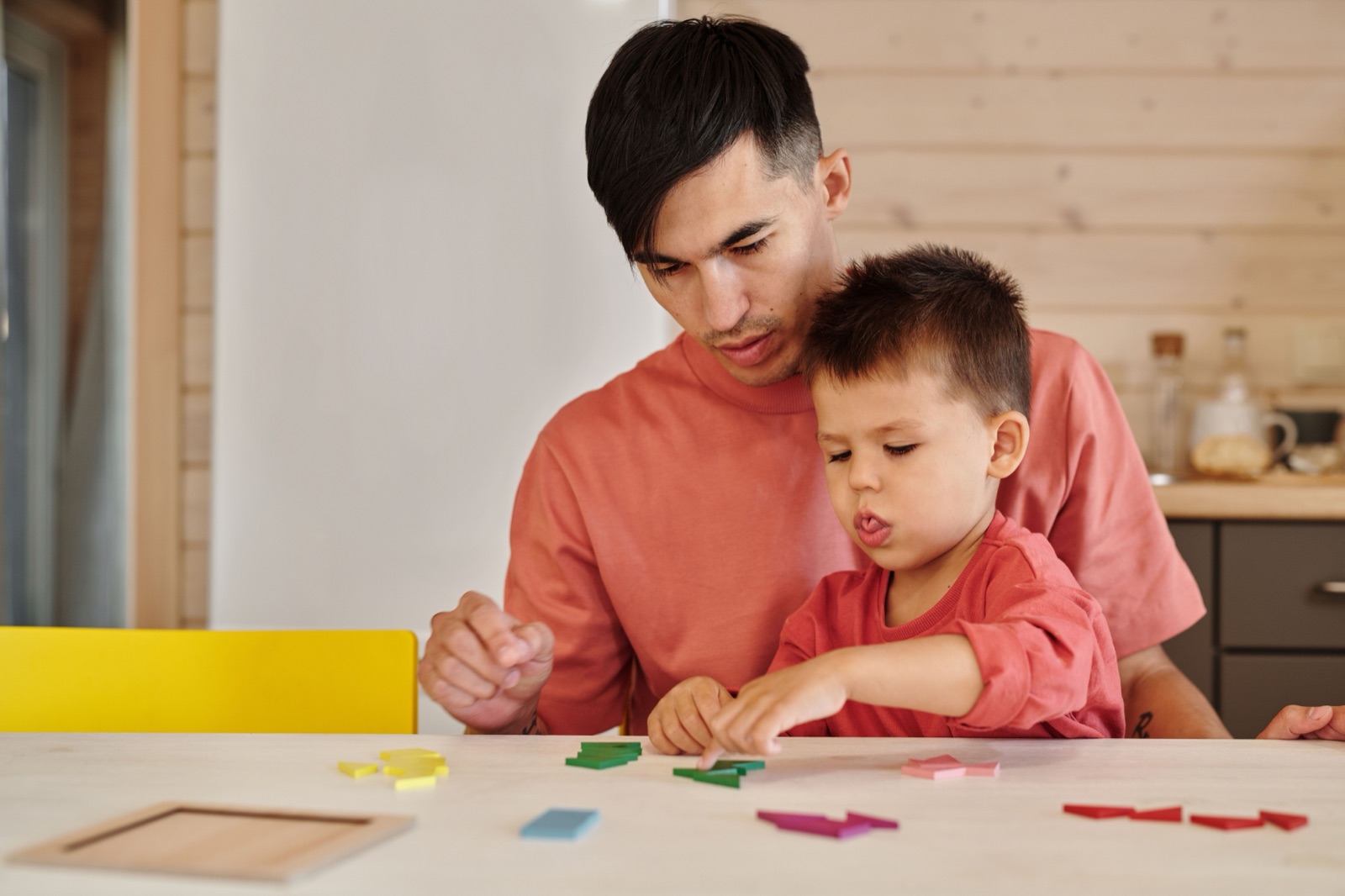
What each kind of talking looks like in an ordinary afternoon
Behavior analysts use some odd words for these skills. You will see them in your child's treatment plan, so here they are with the plain version next to each.
Mand: asking for something
Your child wants the bubbles, so they say "bubbles," sign it, hand you a picture of it or press a button on a device. Then they get the bubbles. This comes first in almost every verbal behavior program, for a simple reason: asking pays off right away. A child who can ask has a working alternative to crying, grabbing or pulling an adult by the wrist.
Echoic: repeating a sound or word
The technician says "ba" and your child says "ba." Copying sounds gives the team a way to prompt new words later. If your child can echo, the technician can say "car" while your child reaches for the toy car, and the echo becomes a request.
Tact: naming what is there
The dog walks in and your child says "dog." Nobody asked and nothing is handed over. The payoff is social: you smile, you say "Yes, there's the dog." Labels are taught with real household objects first (cups, shoes, the cat) before pictures.
Listener responding: following what someone says
You say "Get your shoes" and your child gets their shoes. You say "Where's the spoon?" and your child points to it. This is understanding, and it is taught and measured on its own track, because some children follow far more than they say, and some say more than they follow.
Intraverbal: answering and chatting
"What does a cow say?" "Moo." "Ready, set..." "Go." Intraverbals are words that respond to other words with no object in sight. Songs with a missing last word, fill-in games and simple questions about the day all build them. They are the raw material of conversation, and they come later for most children.
Who pays for it
Verbal behavior goals sit inside a regular ABA treatment plan, so coverage works the same way. We take every Maryland Medicaid plan; ABA is carved out of the Medicaid health plans, so the plan name on your card makes no difference, and with Medicaid there is no out-of-pocket cost. We are in network with CareFirst and TRICARE-certified. On any other employer plan we work with your plan and tell you the exact cost before anything starts. More on the insurance page.
Signs, pictures and talkers all count as language
A request is a request whatever form it takes. The BCBA picks the form most likely to work for your child right now, and that choice gets revisited as skills grow.
Vocal words and word attempts
For children who already make sounds, the plan shapes those sounds toward words. "Ba" for ball is accepted early, then the technician asks for a closer version over time.
Sign
A handful of simple signs (more, eat, help, all done) give a child a way to ask that travels everywhere. Parents learn the same signs during coaching so the whole house speaks them.
Picture exchange
Your child hands you a picture card to get the item on it. Cards are made from the snacks, toys and activities in your home, and they live where your child will reach for them.
Speech-generating devices
If your child uses a tablet or device that speaks, we teach with it. If a speech therapist is evaluating your child for one, our BCBA coordinates with them so both programs use the same vocabulary.
Parents often worry that signs or pictures will stop a child from talking. The American Speech-Language-Hearing Association's guidance on alternative communication treats that belief as a misconception, and notes that these tools can help natural speech when used alongside it. We use spoken words alongside every sign and picture, so your child hears the word each time.
The VB-MAPP and what the BCBA is looking for
Most verbal behavior programs begin with the Verbal Behavior Milestones Assessment and Placement Program, known as the VB-MAPP. It lays out language and learning milestones in three levels, roughly matched to typical development up to about four years old, and checks each of the skills above along with imitation, play, matching and group skills. The ABLLS-R is a similar tool we also use. Either way, the BCBA scores it by watching your child, testing a few items with toys and snacks, and asking you what your child does when nobody is testing.
The VB-MAPP also has a barriers section. It flags things that get in the way of learning, such as frequent crying when asked to do something, repeating lines from shows in place of answering, or a child who only responds to one adult. Those barriers shape the plan as much as the missing milestones do.
What you get from it is a picture of where your child is today, and a short list of first targets. A child with no requests at all starts there. A child who names everything in the house but never asks for help gets requesting goals. A child with plenty of requests and labels moves on to answering questions and back-and-forth talk.
How a session runs
Sessions mix two kinds of teaching. Much of it is natural: the technician notices what your child is after (the iPad, the swing, a bag of pretzels) and makes that the moment to practice asking. Some of it is quicker, structured practice: several short turns in a row on labels or listener skills, mixed with easy tasks your child already knows so the work keeps moving. The BCBA sets the balance for your child.
Prompts are planned and faded. Early on, the technician says the word for your child to echo. Then just the first sound. Then nothing but a pause and an expectant look. Each step is recorded so the BCBA can see whether help is coming down or a target is stuck. Mastered words are mixed back in later to make sure they last, and practiced with other people and in other rooms.
Your part, and who needs to be home
A parent or another responsible adult is home during every session, and parent training is part of every plan. For language, that matters a great deal. Requests happen all day long, and most of them happen when the technician has gone home. The BCBA shows you how to hold out for a request without turning snack time into a standoff, how to model the word, and how much help to give. You practice while the BCBA watches and gives feedback. Our parent and caregiver training page explains the coaching in detail.
Speech therapy and verbal behavior, side by side
We provide ABA, and we coordinate with your child's speech therapist. A speech-language pathologist works on articulation, oral-motor skills, language structure and device selection. Verbal behavior therapy works on getting your child to use communication, many times a day, in your home. When both are involved, our BCBA and your speech therapist agree on target words and on how to prompt them, so your child is not taught "more please" by one adult and "I want more" by another.
Verbal behavior is one part of comprehensive in-home ABA, and for toddlers it overlaps heavily with early intervention. When crying or hitting is standing in for words, the plan pairs it with behavior reduction, which teaches a request in place of the problem behavior. The ABA glossary has more of the vocabulary.
Questions about verbal behavior therapy
If you work with a family who needs ABA, here is how to make a referral. Families can contact our intake team directly; no referral is needed to ask a question.
Where we provide it: verbal behavior therapy happens at home anywhere in Maryland. Local pages: ABA in Owings Mills, in-home ABA in Potomac, Queen Anne's County and ABA therapy in Laurel. With Maryland Medicaid there is no out-of-pocket cost; see how Medicaid covers ABA. No diagnosis yet? Start with an evaluation.
Tell us how your child communicates now
An intake specialist gets in touch by phone or text within a couple of hours on weekdays. Friday and Saturday messages are returned on Sunday.
Related programs: early intervention, social skills, functional behavior assessment. We come to homes in Montgomery County, Baltimore, Anne Arundel County and the rest of Maryland.